




The artificial intelligence industry is overfunded, overvalued, and inflating into danger, according to many insiders and commentators. There will be no “exits” for AI companies valued at billions of dollars with net negative profit margins, the argument goes.
This is an article about why these fears, though grounded in past experiences and a sober view of present market opportunities, are wrong. If anything, we’re undervaluing AI and its potential in the long run. The LLMs that amaze us today will seem primitive in a few short years.
This is a Big Bang, not a bubble. Investors have earned tremendous returns on digital technology that had only modest impacts on productivity. AI will increase productivity more than any other technology humanity has ever conceived. As such, the potential returns on AI are almost unfathomable.
A New Universe for Productivity
Between the dawn of agriculture and the Industrial Revolution, economic productivity barely grew. Basic goods and services (outputs) required a significant amount of skilled labor and labor-intensive materials (inputs). Industrialization introduced new ways of harnessing energy and mechanizing labor, increasing the ratio of outputs to inputs.
What industrialization did for manual labor, AI will do for the entire economy. AI is a Big Bang because it fundamentally changes everything we once knew about productivity.
This cosmic reordering started with English mathematicians Charles Babbage, who conceptualized the first general purpose computer, and Ada Lovelace, who wrote the first program for said computer. Arguably, the Big Bang happened in 1950, when Alan Turing, the father of modern computer science, theorized a “learning machine” that “ … will eventually compete with men in all purely intellectual fields.”

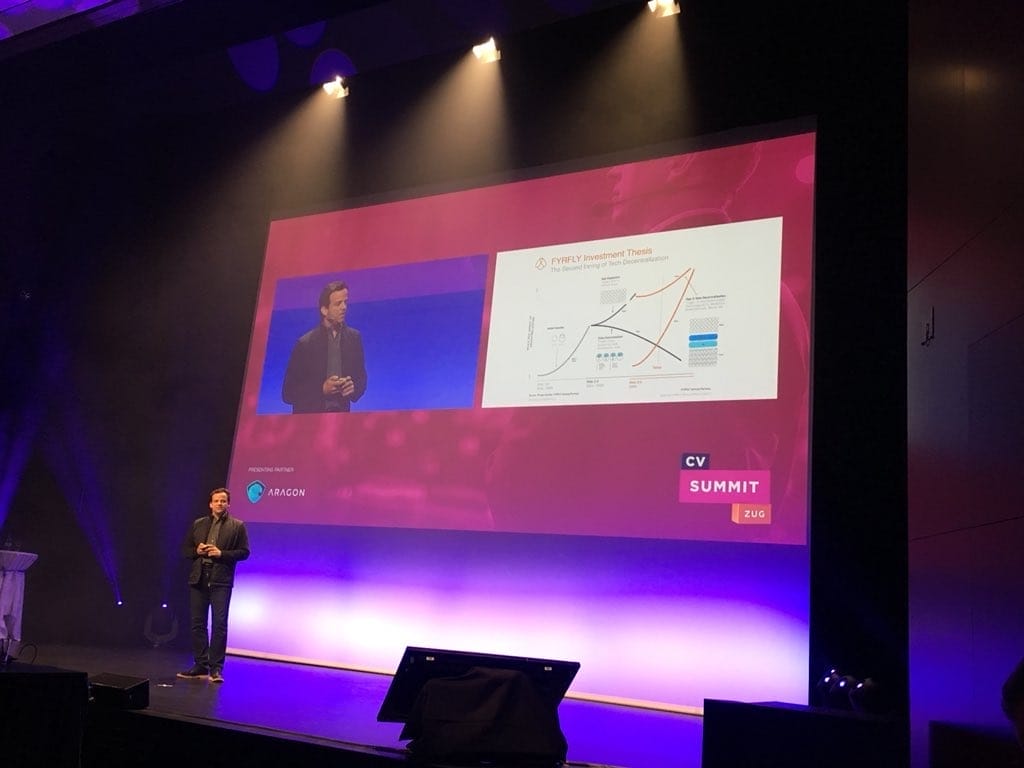
Philipp Stauffer WG04 presents on the future of cryptocurrency, a topic he wrote about for Knowledge at Wharton. (Photo courtesy of Philipp Stauffer)
In the interim, digital innovation did less for productivity than one might expect. Productivity growth in the United States slowed to 1.5 percent between 2002 and 2024 despite revolutions in mobile and cloud computing. Most likely, SaaS merely siphoned capital and revenue away from legacy software without fundamentally changing how anything got done.
Still, like the oversized stars that imploded in our early universe, seeding it with more complex elements, the early digital leaders seeded the AI space with the hardware, software, and infrastructure to commercialize Turing’s learning machine. Out came ChatGPT, Gemini, Claude, Grok, Mistral, and others.
$32 Trillion Investment
To understand the potential returns on AI, we need to consider the returns on pre-AI technology. They are remarkable for how little productivity growth they generated.
Today’s Nasdaq market cap is around $40 trillion, and 80 percent of the companies were originally funded with venture capital. That’s about $32 trillion with VC origins. Since the inception of the VC industry in the 1940s, some $1.2 trillion to $2.5 trillion in venture capital has been deployed in the US. If we assume all of these investments led to public Nasdaq companies eventually (including through M&A and acquisition of talent and know-how from failed companies), a growth of 16x to 33x was achieved.
Now, considering that the vast majority of those investments happened in the past 10 to 15 years, we can calculate a range of IRR values from 37 percent ($2.5 trillion in investments in the past 15 years) to 68 percent ($1.2 trillion in investments in the past 10 years). Most investors would get teary-eyed imagining those returns, let alone achieving them — even with a risky asset such as venture capital. That’s a massive return for technology that had only a moderate impact on American productivity! For AI that is expected to improve productivity at rates unseen in human history, the scale of potential returns is hard to comprehend.
The AI Value Chain
AI has begun to attend to its own development, advancing its intelligence at scales and speeds that have no precedent. And although many AI ventures will burn bright and implode, as companies often do, the survivors will become like our Sun. Entire planetary systems of vertical software and robotics will orbit them, carrying intelligence into every industry. But what will these solar systems look like?
Consider the pre-AI value chain of Elon Musk [C97 W97], which I compared to Alfred Escher’s Switzerland in Knowledge at Wharton years ago. Musk started with an electric car company (Tesla) that manufactured its own batteries (Gigafactory), acquired systems to power the battery (SolarCity), and built infrastructure for solar-powered mobility (The Boring Company). Meanwhile, Musk built a rocket company (SpaceX) that developed an array of satellites to deliver internet connectivity worldwide (Starlink), including to self-driving Tesla vehicles.
Now add to this picture an AI that is vastly more intelligent than Grok, GPT, Claude, or any other existing LLM. It enables Tesla robots (Optimus) to automate a variety of tasks including, eventually, everything between mining critical minerals and manufacturing them into power systems, satellites, and robo-taxis. Starlink satellites and Tesla power systems ensure that Optimus robots can work in the remote places where critical minerals are usually mined. Moreover, Starlink arrays orbiting Mars enable robots to colonize the planet, extract resources there, and create habitable space for human beings (Musk’s insurance policy for planet Earth).
Musk could open this solar system to other players that license his AI models, Tesla power systems and robots, Starlink connectivity, etc., to offer distinct products and services — marketed, of course, on X.com. Those become the planets, moons, asteroids, and other space objects in the solar system. Or Elon Musk’s ecosystem of companies might themselves become part of a planetary system orbiting an AI superior to anything xAI can produce proprietarily. It’s too soon to tell.
Don’t Look at the Blast
Today, we live in the aftermath of a Big Bang triggered by Babbage, Lovelace, and Turing. This is an infant technological universe with a rapidly expanding opportunity space. AI companies are from the future. Their impact on productivity won’t register for another two to three years, at the very least, but then the gains will start to compound. Meanwhile, we’re underestimating their value and underfunding their potential.
To be clear, there is currently a lack of exit opportunities in this heavily funded space. The AIs bound to survive this early universe don’t need exits yet. Traditional and alternative liquidity events will allow existing investors to take money off the table while enabling new investors to get a foot in the door.
An IPO for OpenAI or Anthropic would ease pressure to make AI economics work. Whether to keep or sell OpenAI and Anthropic post-IPO could be the most consequential decision investors make this decade. One thing is already clear: Foundation models that fundraise, spend, and scale extravagantly in pursuit of AGI will leave themselves vulnerable to upstarts with more capital-efficient approaches.
AI is bubbly, and when some of its early stars explode, it’s going to hurt. Everyone staring at the blast, however, risks being blinded to the bigger trend. We must not conflate the AI industry with LLMs, which are only one way of going about AI and solve only a fraction of the productivity problem set. LLMs might become akin to LaserDiscs, today remembered for being comically oversized and overpriced. Investments in AI inference infrastructure and the application layer with vertical AI solutions are coming, either way.
AI’s impact on productivity will be unlike anything prior, regardless of whether our early AI players persist or go extinct. This is a Big Bang for entrepreneurs and investors — and hopefully for human flourishing.
Philipp Stauffer WG04 is the co-founder and managing partner of FYRFLY Venture Partners, an enterprise deep tech venture firm based in Silicon Valley and Switzerland. Having grown up in a family of entrepreneurs, Philipp followed his passion for innovation early on, launching consumer products to the European markets right out of school. He has held roles at the frontier of technology innovation and technology as a founder, leader, and investor, working with companies such as Accenture, Salesforce, Amazon, Micron, Interpublic, and Google. Philipp is an honorary ambassador to Switzerland and currently lives in the San Francisco Bay Area.